Driving in Argentina with a UK Licence: What You Need to Know
You can drive in Argentina on a UK licence for up to 6 months, but the rules for converting, insuring, and actually surviving on Argentine roads are worth understanding.
 Thomas SinclairWriter and editor · London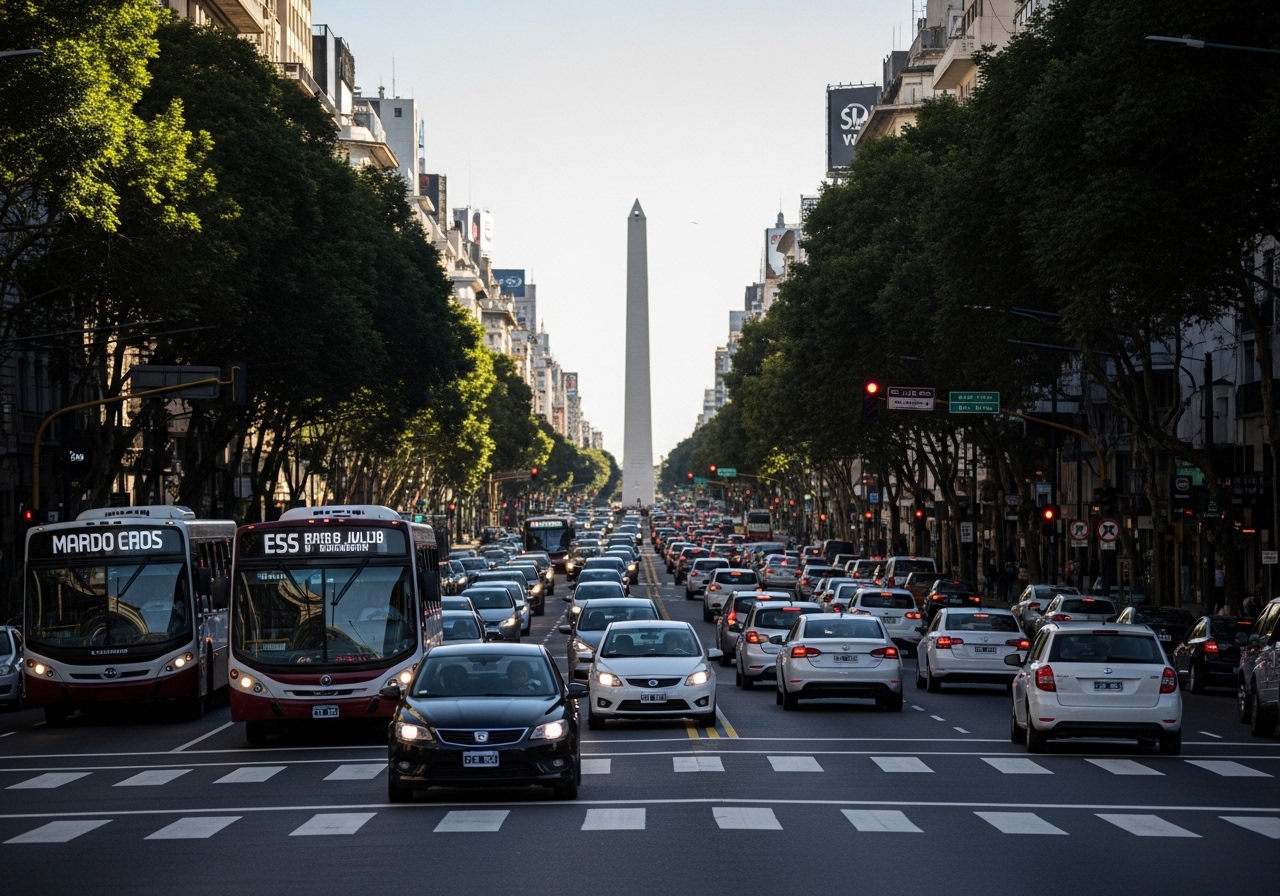
The lane markings in Buenos Aires are decorative suggestions. Once you accept this, driving becomes much less stressful.
Driving in Argentina is a legitimate lifestyle choice for some expats — particularly those living outside Buenos Aires or planning to explore the country. But if you're living in the capital, you properly don't need a car. Buenos Aires has an extensive public transport network (Subte, buses, and ride-hailing apps) that's cheap and efficient.
That said, having a car opens up Argentina dramatically — weekend trips to the countryside, wine country, the coast, Patagonia. If you're going to drive, here's what you need.
Using Your UK Licence
First 6 months: Your UK photocard driving licence is valid in Argentina. However, you should also carry an International Driving Permit (IDP) — available from the Post Office in the UK for £5.50. While not strictly required by Argentine law for UK licence holders, an IDP provides a Spanish translation that Argentine police recognise immediately. Without one, a traffic stop could involve lengthy explanations.
After 6 months: You need to convert to an Argentine driving licence. This applies to anyone establishing residency.
Converting to an Argentine Licence
The process varies by municipality (it's local government, not national), but in Buenos Aires City (CABA), the process is:
Requirements:
- DNI (Argentine national identity card) or proof of residency proceedings
- Proof of address in CABA (utility bill or rental contract)
- Blood type certification (yes, really — from any clinic, costs about £5)
- Medical exam (vision, hearing, basic physical) — done at the licensing centre
- Psychological exam (brief interview) — also at the licensing centre
- Theory test (multiple choice, available in Spanish and English)
- Practical driving test (short road test)
Cost: Around ARS 15,000–25,000 (£10–17)
Tips:
- Book your turno (appointment) at the Dirección General de Tránsito (CABA) well in advance — slots fill up
- Study the Argentine traffic laws — they differ from UK rules in significant ways
- The theory test is straightforward but specific to Argentine regulations
- The practical test is easier than the UK test — usually a short circuit through nearby streets
The whole process takes half a day if your appointment is on time.
Right-Hand Driving
Argentina drives on the right. If you've driven in continental Europe, the adjustment is similar. If you've only ever driven on the left, give yourself 2–3 weeks of cautious practice.
Key adjustment points:
- Roundabouts go anti-clockwise (opposite to UK)
- Right turns are the easy ones; left turns across traffic are where your instincts will be wrong
- The driver sits on the left side of the car — your spatial awareness for the passenger side needs recalibrating
- Overtaking happens on the left (same side you're used to in the UK, but the dynamics feel different)
- One-way streets in Buenos Aires form a grid pattern — alternating directions
The single most dangerous moment: Leaving a petrol station or side road and instinctively pulling into the left lane. This gets safer with practice but remains a risk for the first month.
Buenos Aires Traffic
Buenos Aires traffic is dense, noisy, and aggressive by British standards. Some realities:
Lane discipline doesn't exist. Three-lane roads regularly carry four or five lanes of traffic. Cars will squeeze into gaps that wouldn't be gaps in the UK.
Motorcycles and scooters weave between lanes at all speeds. They appear from nowhere, constantly.
Traffic lights are respected (mostly), but there's a culture of creeping forward on red and accelerating hard on green. Yellow means "speed up" to most porteños.
Pedestrian crossings exist but pedestrians don't have the same assumed priority they do in the UK. Make eye contact with drivers before stepping out.
Parking in central Buenos Aires is a challenge. Metered street parking exists but spaces are scarce. Private garages (cocheras) cost £50–100/month in Palermo, less in outer neighbourhoods.
The colectivo (bus) factor: Buenos Aires buses are large, frequent, and driven with great confidence. They will pull out, they will stop suddenly, and they have priority in practice if not always in law. Give them space.
Outside Buenos Aires
Driving outside the capital is pleasant. Argentine highways (autopistas and rutas) are generally well-maintained on major routes. The landscape is superb — from the Pampas to the Andes.
Key route considerations:
Ruta 40 (the famous north-south road through Patagonia): partially unpaved in sections. A high-clearance vehicle is recommended for the southern stretches.
Wine country (Mendoza): Excellent roads, stunning scenery. The drive from Buenos Aires to Mendoza is about 12–14 hours on the RN 7 autopista, or a 2-hour flight.
The coast (Mar del Plata, Pinamar): 4–5 hours on the Ruta 2 autopista from Buenos Aires. Very busy on holiday weekends — leave early or late.
Patagonia: Long distances between fuel stops. Carry extra fuel if you're going off the main routes. Wind can be extreme — enough to push a car across a lane.
Speed limits:
- Urban: 40–60 km/h
- National roads: 110 km/h
- Autopistas: 120–130 km/h
- These are routinely exceeded — but speed cameras (radares) are increasingly common
Insurance and Costs
Mandatory insurance: Third-party liability insurance (seguro contra terceros) is legally required. Basic cover costs ARS 15,000–30,000/month (£10–20). Comprehensive cover (todo riesgo) runs ARS 30,000–75,000/month (£20–50) depending on the car.
Fuel: Argentina's fuel prices are moderate — roughly £0.70–0.90 per litre for premium nafta (petrol). Diesel is slightly cheaper. Fuel prices are government-regulated and change periodically.
Tolls: Highway tolls are common on autopistas. A Buenos Aires–Mendoza trip accumulates roughly £15–25 in tolls.
VTV (Vehicle Technical Verification): Annual MOT equivalent, required for all cars. The process is similar to a UK MOT — inspection at an authorised centre. Cost: roughly £20–30.
Should You Bring Your UK Car?
Almost certainly not. Importing a car to Argentina involves:
- Import duties of 35%+ on the assessed value
- Complex customs paperwork (3–6 months)
- The car must meet Argentine emissions and safety standards
- Right-hand drive vehicles are legal but impractical on Argentine roads
- You'd need to convert all instruments to metric
Buy or rent a car in Argentina instead. Second-hand car prices are high (cars hold value well in Argentina due to import costs), but it's still more practical than shipping.
Frequently Asked Questions
Can I drive in Argentina with a UK driving licence?
Yes — your UK photocard licence is valid for up to 6 months. Carry an International Driving Permit (IDP) as well for ease with police checks. After 6 months of residency, you need to convert to an Argentine licence through a medical exam, theory test, and practical test at your local licensing office.
Is it worth having a car in Buenos Aires?
For daily life, most expats find a car unnecessary — the Subte, buses, and ride-hailing apps (Uber, Cabify) are cheap and comprehensive. A car becomes valuable for weekend trips to the countryside, coast, or wine country. Many expats use a combination: no car for the city, rental cars for trips, or car-sharing services.
How do I get an Argentine driving licence?
Apply through the Dirección General de Tránsito in your municipality. In Buenos Aires City (CABA), you need: DNI or residency proof, proof of address, blood type certificate, medical and psychological exams (done on-site), a theory test (available in English), and a practical road test. The whole process can be completed in a day. Cost is approximately £10–17.
Sources & Official Links
- Dirección General de Tránsito — CABA— Buenos Aires City licensing procedures
- FCDO Driving Abroad — Argentina
Related Guides
 Daily Life
Healthcare in Argentina for UK Expats: What Replaces the NHS
Argentina has two healthcare systems — a public one and a private one. For British expats, the private sector (prepaga) is where you'll want to be.
Read guide → Daily Life
Working Remotely from Buenos Aires: The Practical Reality
Buenos Aires works well for remote workers. The café culture is excellent, the internet is generally solid, and the time zone is manageable for UK clients.
Read guide → Daily Life
Moving to Argentina with Children: Schools and Family Life
Buenos Aires has several really excellent British-curriculum schools. Getting the right one — and understanding the Argentine education landscape — takes some homework.
Read guide →